THE ESTATE
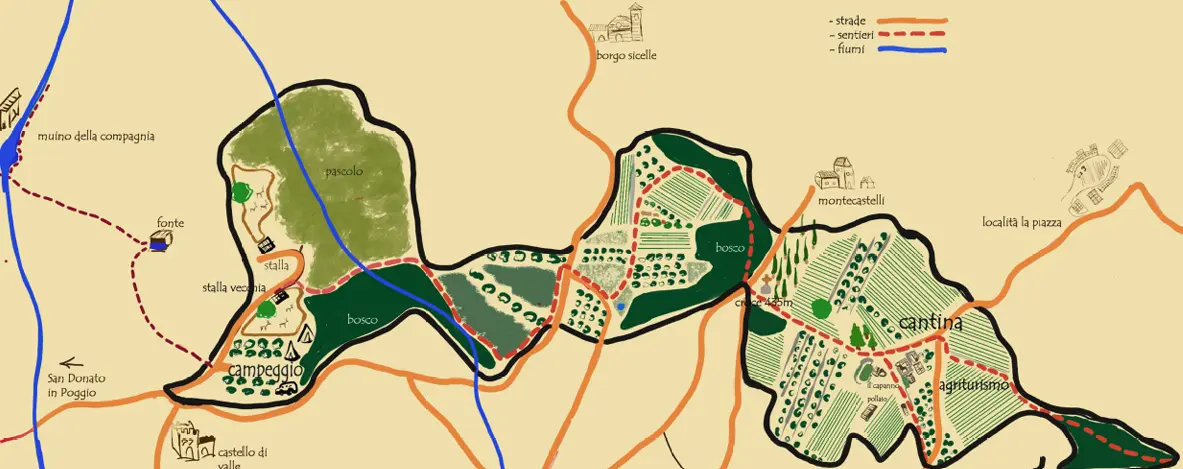
The Casavecchia alla Piazza farm, run by Gabriele Buondonno and his children Marta and Errico, straddles the provinces of Siena and Florence, between the medieval villages of Sicelle and La Piazza. The estate unfolds around the ancient Casavecchia farmstead, dating back to the 12th century. The property sits on the sunny side (south/south-east) of the hill, surrounded by vineyards and olive groves, partly cultivated on ancient terraces that climb the ridge up to the cypress grove crowning the hill at 500 metres above sea level. Descending the north-facing slope, beyond a wooded area, lie the new vineyards and other centuries-old olive groves; further north the vines give way to pastures and woods where the goats graze freely. At the far end of the estate stand the stables and the farm campsite.
Since its founding the estate has embraced respect for the land and simplicity as core values, both in farming and in daily life, honouring the rhythms of nature and rural traditions. Modern technology and machinery are of course necessary, but wherever possible their use is limited in favour of sustainable agronomic practices rooted in organic farming.
HISTORY
It all began in 1988 when Gabriele and his wife, after studying in their hometown of Naples, set out to find a place to start a farming project and discovered the Casavecchia Alla Piazza estate.
The farmstead, at the time in a state of semi-abandonment, is nestled among the hills of Chianti Classico, where winemaking has a thousand-year history stretching back 4,000 years to when the Etruscans first introduced the vine.
It was precisely the cultivation of the vine that captivated Gabriele, and starting from two hectares of old vines purchased with the estate, with great passion and hard work he gave life to what the estate is today.
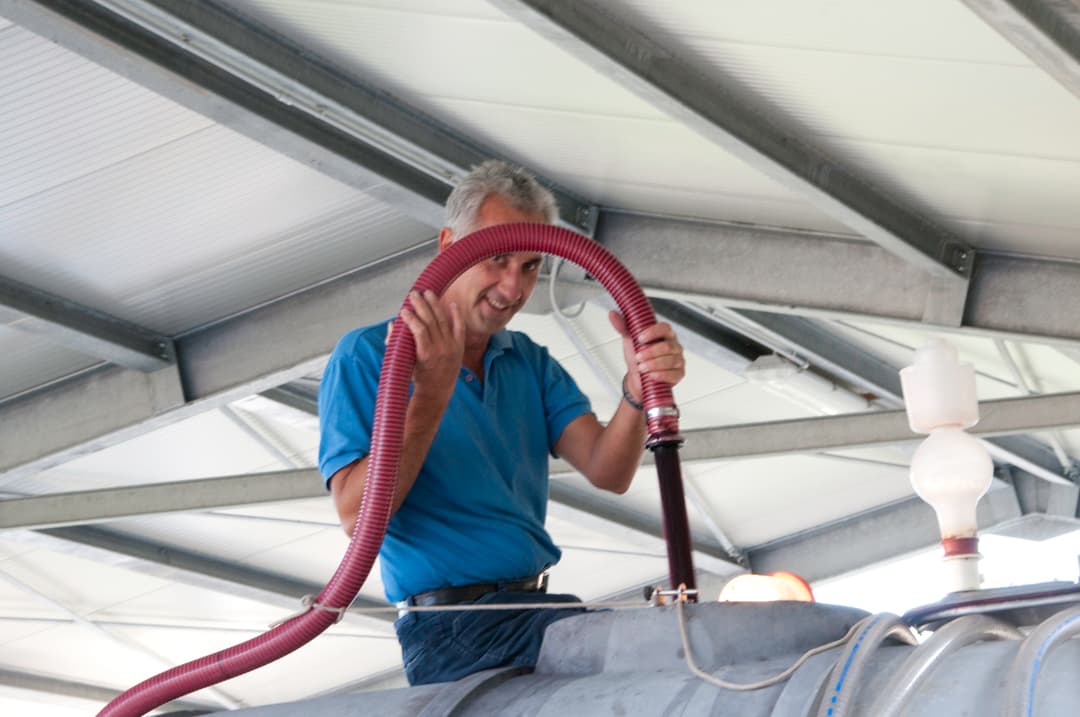
The first vinification took place in 1989 in a makeshift cellar with very little equipment. Since then the estate has grown, yet the philosophy has remained that of the early years: organic farming that strives to have the least possible impact on the land, and a winemaking approach devoted to simplicity, with spontaneous fermentations and minimal intervention. Today Gabriele's son Errico continues in his father's footsteps in wine production, while his daughter Marta, through the Apicorno project, has started a goat herd for cheese making.
Casavecchia Alla Piazza formerly Casino di Buonarroti
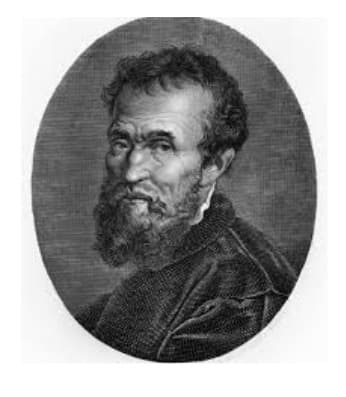
In the maps of the Captains of the Guelph Party from 1549, the estate appears prominently and is marked as the "place of Lionardo Buonarroti", Michelangelo's nephew.
From the correspondence between the uncle, then 74 years old and living in Rome, and his nephew, we learn that the Casavecchia alla Piazza estate was purchased by Michelangelo and that even then the wine produced in this area was renowned: "I would rather have two barrels of Trebbiano than eight shirts," Michelangelo wrote to Lionardo, adding that he wished to make a gift of it to the Pope.
Gabriele Buondonno
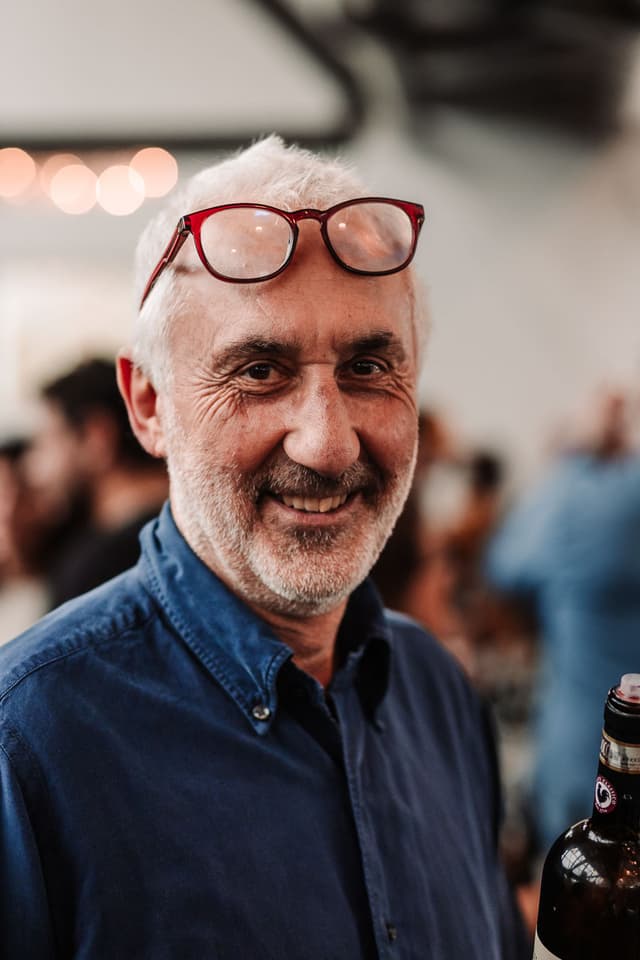
Gabriele, after studying agriculture in Naples, his hometown, purchased the estate in 1988 together with his wife. Here, with dedication and perseverance, he devoted himself to organic viticulture, building what the estate is today.
Marta Buondonno
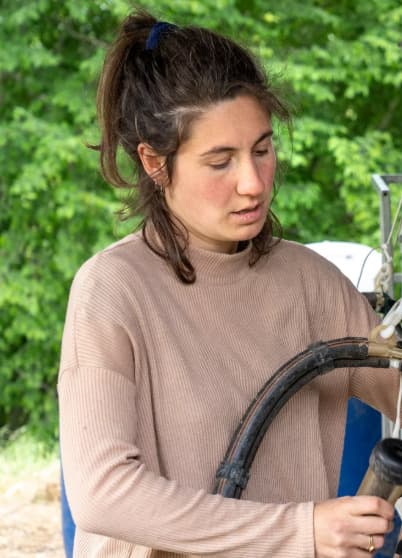
Marta, born and raised on the estate, after studying biology and agriculture in the Netherlands, developed a passion for cheese-making and animal husbandry. In 2015 she founded L'Apicorno, a project still growing, which today includes a herd of about 50 goats and the production of several types of cheese, along with honey production and farm-camping hospitality.
Errico Buondonno
Errico, also raised on the estate, studied economic development and international cooperation before returning to follow in the family's footsteps. After a master's degree in viticulture at the Sant'Anna School in Pisa, he now dedicates himself to wine production and helps manage the estate.
VINEYARDS
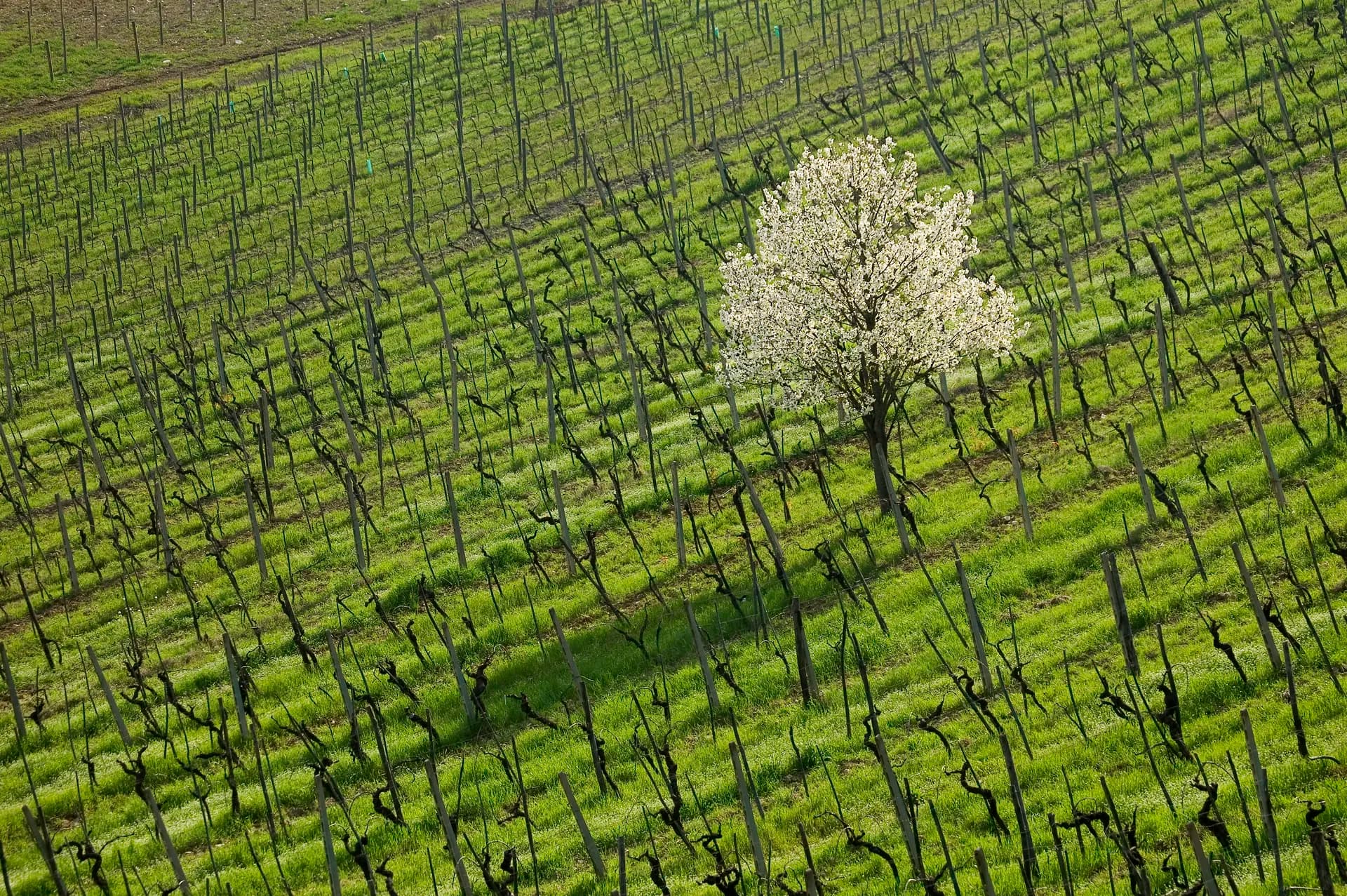
The vineyards are largely located around the Casavecchia estate at an average altitude of 425 m a.s.l., with southern, south-eastern and eastern exposure. In the nearby locality of Sicelle (400 m a.s.l.) we have a small north-east-facing vineyard and an old rented vineyard — Sicellino — dating from the 1970s, facing NE.
The soils originate from a consolidated mineral substrate of silty clay-schists ("galestri") with marly limestones ("alberese") and calcareous sandstones ("pietraforte"); they are moderately deep, with a clay-loam texture, very calcareous and with abundant stony skeleton ensuring good drainage.
Since 1992 we have renewed a large part of the oldest vineyards using Sangiovese clones selected for low yields and the production of small-berried clusters, thus characterised by a better skin-to-must ratio. We have also introduced new varieties such as Syrah, Merlot and Cabernet Franc.
PIONEERS OF ORGANIC FARMING
From the very beginning of our activity we turned to Organic Farming because it seemed — and still seems — the best way to tread lightly on the natural environment, seeking to disturb its balance as little as possible.
Since 1989, with membership number 17, we have been enrolled in the Coordinamento Toscano Produttori Biologici — www.ctpb.it — one of the first organic-producer associations founded in Italy.
In 1995 we co-founded, together with a group of small organic wineries from Tuscany and Piedmont, the Trimillii association — Friends of Piedmontese and Tuscan Winemakers, later turned into a consortium through which we took part in numerous trade fairs and exhibitions and experimented with new forms of promotion and collaboration until 2013.
In 2016, together with various Chianti producers and operators committed to environmental protection, we founded the Biodistretto del Chianti, whose aim is to promote organic farming and all those good practices aimed at respecting the land and the environment as much as possible.
organic viticulture
Soil work is kept to a minimum and consists of light harrowing on alternate rows — since half the rows are permanently grassed — and a shallow tillage along the row to contain weed competition close to the plants.
We often sow green-manure seed mixes on alternate rows to increase organic matter and soil porosity.
Fertilisation and pest treatments are carried out with natural products permitted under EU Reg. 834/2007 governing Organic Farming. On the estate we also produce small quantities of compost, mainly from grape pomace and goat manure, which we then use in the younger vineyards and the kitchen garden.
With an exclusively manual harvest we pick the grapes and bring them to the cellar, where the must ferments naturally in cement and steel tanks. Once fermentation is complete, after a resting period in outdoor tanks, we move the wine to the ageing cellar where it rests in large wooden casks for one to three years.
The L'Apicorno farm was born in the autumn of 2015 from a few initial building blocks: a dozen beehives and four Chamois goats, but above all from the desire to create a sustainable farming project as an alternative to viticulture, one that would be as much in harmony as possible with the rhythms of the land and respectful of its biodiversity.
From the very beginning, the heart of the activity has been the attempt to build a respectful and loving relationship with our animals, while being aware that any form of productive farming inevitably brings contradictions that we strive to face every day with dedication.
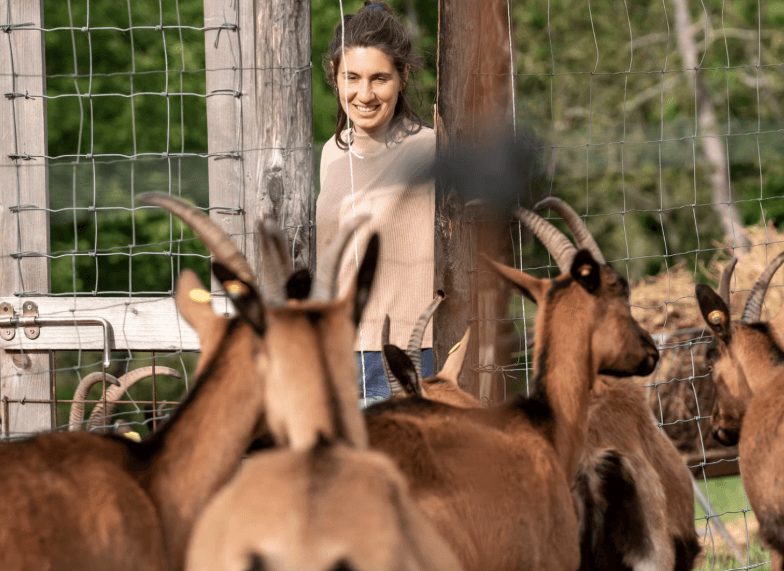
The herd today numbers 50 Alpine Chamois goats raised in a semi-free-range system, grazing for most of the year on the estate's land.
All the goat's milk is transformed in a small on-farm dairy, where various types of raw-milk cheese are produced — from fresh robiola to French-style bloomy-rind cheeses and aged toma wheels matured for several months.
About ten beehives are housed on the estate and produce excellent honey from local blossoms.
L'Apicorno today also includes a farm campsite, hosting tents or vans from April to November. The project promotes a kind of tourism connected to nature and agricultural production.